Boar Bristle Hair Brushes: Sourcing, Grading, and the Import Compliance Most Buyers Miss
The Only Beauty Tool That Can Be Refused at the Border
Ask a buyer what can go wrong with a hair brush order and you will hear about shedding bristles, cracked handles, and pads that detach. Those are quality problems. They are annoying, they are negotiable, and they get solved with a spec change and a re-order.
Boar bristle carries a second category of risk that no other item in a typical accessory program has. It is an animal by-product, and that means it sits inside a veterinary and customs regime that has nothing to do with how well the brush was made. A perfectly manufactured bristle brush can be held at a border control post because the paperwork describing where the bristle came from and how it was treated does not match what the consignment actually contains. The brush did nothing wrong. The documentation did.
This is not a hypothetical edge case. It is the predictable result of how this category is normally bought. Most buyers specify "natural bristle," receive a quote, compare it against a synthetic alternative, and treat the difference as a material preference. In reality, choosing boar bristle pulls your program into a set of origin, treatment and certification requirements that most RFQ templates never mention.
The good news is that none of this is difficult once you know it exists. The grade question is answerable in one email. The blend question is a decision, not a discovery. The paperwork question is four specific documents you can request before you place the order rather than after the container sails.
This guide covers what boar bristle actually is, how it is graded, where blends fit, what vegan alternatives can and cannot do, and the compliance path that most buyers only learn about the hard way.
Where Boar Bristle Programs Fail
Almost every serious problem in this category traces back to something that was unspecified rather than something that was done badly. Here is the pattern we see repeated.
| Failure | What It Looks Like | Root Cause | The Spec That Prevents It |
|---|---|---|---|
| Shedding | Bristles come out in the hand within weeks | Tuft anchoring under-specified; adhesive-only fixing on a premium SKU | Drilled-and-tufted construction, stated anchoring method, pull test at PP approval |
| Grade inflation | "100% boar bristle" that feels stiff and scratches | Lower-cut bristle quoted as first-cut | Cut level stated as a percentage of total bristle, in writing |
| Odour complaints | A smell on opening the retail pack | Bristle not fully cleaned or not fully dried before packing | Sealed-bag odour test at 48 hours, moisture limit on packed bristle |
| Blend misdeclaration | A "pure bristle" claim that is actually 50/50 | Blend ratio never specified, only "boar bristle" | Blend ratio by weight or by tuft count, declared on the spec sheet |
| Held at import | Consignment stops at a border control post | Missing or mismatched animal-origin documentation | Origin, treatment method and certificate number collected before the PO |
Note what the last row has in common with the others: it is a specification gap, not a manufacturing defect. The difference is that the first four cost you margin, and the fifth can cost you the shipment.
What Boar Bristle Actually Is
Boar bristle is the stiff hair from the back and neck of domestic pigs. It arrives as a by-product of meat production, which is the origin of every compliance obligation discussed later in this article — the material is regulated because of what it is, not because of what it was made into.
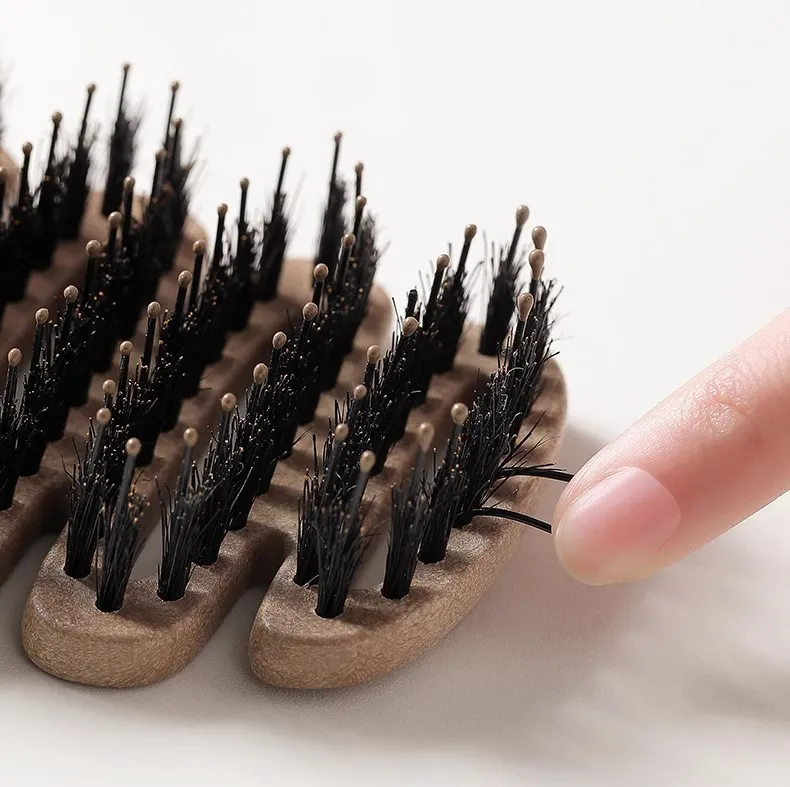
Structurally, boar bristle differs from a synthetic filament in one way that matters commercially: each strand carries a microscopic scale structure along its length and tapers to a naturally fine tip. That structure is the reason the material has a function rather than just a story. Drawn through hair, the scales pick up sebum at the scalp and carry it down the shaft, and the tapered tip smooths the cuticle rather than abrading it. A cylindrical extruded filament, however well made, does not do this — it can be engineered to feel similar, but the mechanism is different.
This is the same reason natural hair is still specified in cosmetic brushes despite two decades of synthetic improvement, and the sourcing logic carries over directly: grade determines performance, origin determines paperwork. If you work across both categories, the bristle material comparison for cosmetic brushes covers the parallel decisions on the makeup side.
The Core Variable Nobody Specifies: Bristle Grade
If you take one specification action from this article, make it this one.
Natural bristle is graded by cut, which refers to which portion of the strand is used. A bristle has a root end and a tip end. Root-end material is coarser and stiffer; tip-end material retains the natural taper that gives premium brushes their glide. First-cut bristle keeps the tapered tip. Lower cuts are trimmed blunt, which is faster, cheaper, and noticeably harsher on the scalp.
Two suppliers can both quote "100% boar bristle" and be describing products that a customer would never confuse. That is the entire grade problem in one sentence.
| Grade Parameter | Why It Matters |
|---|---|
| Cut level | Decides softness, glide and price more than any other single variable |
| Length | Longer bristle gives more flex and a softer feel; short bristle is stiffer and cheaper |
| Root-end vs tip-end orientation | Which end is anchored into the brush changes how the brush feels entirely |
| Colour sorting | Natural bristle varies; unsorted bristle looks inconsistent across a retail shelf |
| Down / undercoat content | Fine undercoat fibres mixed in reduce cost and reduce performance |
The Blend Ratio: Where Performance and Price Actually Meet
Very few commercial programs use pure first-cut boar bristle. It is expensive, it is soft enough that it does not detangle thick or wet hair well, and it is slow to dry. The commercial default is a blend.
| Construction | How It Behaves | Relative Cost |
|---|---|---|
| 100% boar, first cut | Maximum shine and smoothing, minimal grip on thick hair | Highest |
| Boar-dominant blend (~70:30 boar:nylon) | Mostly natural feel with enough nylon to grip and detangle | High |
| Balanced blend (~50:50) | Noticeably natural but functionally a detangling brush | Moderate |
| Nylon-dominant with a boar outer ring | Grip and speed first, natural finish second | Moderate |
| Tapered synthetic ("vegan boar") | Engineered taper, no animal content | Moderate |
Two practical notes.
First, specify the ratio by weight or by tuft count, and say which. A 70:30 blend by weight and by tuft count are different products, because nylon filaments and boar bristle do not weigh the same per strand.
Second, decide where the boar sits. Bristle in the outer ring of a round brush contacts the hair surface and delivers the finish; bristle distributed through the whole field changes grip across the entire brush. Same ratio, different brush. This is the variable most RFQs leave entirely to the factory.
Then There Is the Vegan Question
For some programs the bristle decision is not about performance at all — it is about whether animal content is acceptable to the brand, the retailer, or the market.
Modern tapered synthetic filaments have closed most of the sensory gap. A good tapered PBT filament mimics the soft tip and much of the glide. What it does not replicate is the sebum-carrying mechanism, and that distinction matters for how you word the claim. You can honestly describe a tapered synthetic as giving a smooth finish. You should not imply it distributes natural oils in the way a natural bristle does, because the mechanism genuinely is not there.
Where vegan matters, the decision usually is not really about the bristle — it is about avoiding the documentation burden described in the next section. A synthetic-bristle program does not carry animal by-product paperwork at all, and for a buyer assembling a multi-market program, that can be worth more than the small performance difference.
We cover the material choices and claim discipline for accessory programs in the sustainable materials guide, and the parallel discussion on the cosmetic side in the vegan brush trends analysis.
The Part Most Buyers Have Never Heard Of: Bristle as an Animal By-Product
Here is the section that will save a shipment.
Under EU Regulation (EC) No 1069/2009 and its implementing Regulation (EU) No 142/2011, pig bristles are Category 3 animal by-products. That classification is what generates the import conditions. Equivalent regimes apply in Great Britain, where the relevant guidance sits in the import information notes issued by the authorities.
What this means in practice:
Origin and establishment must both be approved. Bristle must come from an approved country or region and an approved establishment. If the establishment is not on the right list when veterinary checks are carried out, the consignment is likely to be held and can be rejected, re-exported or destroyed.
Treatment is where most programs get caught. Untreated bristle must be dry and securely enclosed in packaging. Where the bristle originates from a region that has reported African swine fever within the previous twelve months, the bristle must have been boiled, dyed or bleached, or have undergone some other treatment certain to kill pathogenic agents, evidenced by a certificate from the veterinarian responsible for the place of origin.
Four Documents to Collect Before the PO, Not After It
- Animal-origin declaration — species, country of origin, and treatment method.
- Treatment evidence — specifically what was done (boiled, dyed, bleached, or another validated method), not a general statement that the bristle was "processed."
- Health certificate reference — the model certificate used, and confirmation of which disease-status pathway applies.
- Approved establishment details — the establishment number, and confirmation it appears on the correct list for your destination market.
For the wider compliance picture across accessory categories — product safety, labelling and chemical requirements that apply regardless of bristle content — see the compliance scope map for beauty accessories.
FAQ
Is boar bristle actually better than synthetic, or just more expensive? It does something synthetic does not: the scale structure carries scalp oils along the hair shaft, which is a real and demonstrable effect. It is not better at everything — it grips less on thick or wet hair, and it dries slowly. The honest framing is mechanism, not superiority: if the product promise is shine and smoothing, natural bristle earns its price; if the promise is fast detangling, a good synthetic will usually outperform it for less money.
What does "100% boar bristle" actually guarantee? Very little on its own. It guarantees the bristle content is not synthetic, and nothing about cut level, length, orientation or origin — which are the variables that determine how the brush performs. Two brushes both legitimately described as 100% boar bristle can differ in cost substantially and feel completely different. Always specify the grade underneath the claim.
Does this paperwork apply if I import finished brushes rather than raw bristle? It depends on the product, the processing the material has undergone, and the destination market — and this is exactly the question to put to your broker rather than to a supplier or an article. The safe operating assumption is that animal content in a finished good will attract questions, and that having the origin and treatment documentation ready costs far less than assembling it while a container waits.
Closing: Specify the Material, But Also Specify the Paperwork
Boar bristle is worth sourcing. It does something no synthetic filament does, customers recognise the difference, and it supports a price point that synthetics struggle to hold. The category's problem has never been the material.
The problem is that buyers specify the brush and leave the bristle — and then discover, at a border control post, that the bristle was the part with rules attached.
Grade, blend, placement, origin and treatment are five decisions. Make them at RFQ stage, put them on the spec sheet, and request the four documents as part of sample approval. Do that and a boar bristle program runs like any other.
Talk to our team about a natural bristle program — or start with the category detail:
Beauty Accessories Freight & Duty Guide 2026
Related Article